South Tyneside Youth Justice Plan 2024 - 2026
Published 02 October 2025 An accessible strategy document from southtyneside.gov.uk
Foreword
It is my great privilege to have assumed the role of chair of the Youth Justice Management Board (The Board) and to introduce our Youth Justice Plan setting out our ambitions to deliver a high-quality Youth Justice Service (YJS) supporting children and young people and preventing youth crime in South Tyneside.
As with previous years, our Youth Justice plan is developed and agreed by our youth justice partners who are responsible for the governance arrangements regarding its delivery.
Our plan gives an overview of the work of the Youth Justice Service and lays out details of performance over the past year, and our focus and priorities for the year’s ahead with a commitment to partnership working.
The priorities for the year ahead have been developed based on the analysis of our performance data, partner priorities, and, most importantly, what children and young people, families, victims and communities tell us matter’s to them.
2024-26 will see the YJS continue its journey of improved performance and outcomes, delivering against the revised key performance indicators. Our partnership arrangements are recognised as a strength in the borough, which going forward will enable the development of a child first, whole - system approach. Building on relational and restorative practice and children’s strengths, we will pursue our aim of diverting children away from the criminal justice system.
We are a learning service and will continue to strive to learn and develop, not only looking internally but also regionally and nationally and participating in sharing the voice of children and families.
The continued challenge for us is to build upon the progress and success to date, effectively utilising the services and opportunities available to us. This will achieve safer and stronger communities, and improved life opportunities and outcomes for children and young people.
On behalf of The Board I would like to express thanks to the Youth Justice Service staff, the wider Children’s Services workforce and our partners who support our children and I commend the achievements we’ve collectively made in 2023.

Introduction, Vision and Strategy
Local Context
South Tyneside lies just Southeast of the city of Newcastle upon Tyne and is bordered by the River Tyne to the North and the North Sea to the East. As a coastal town, South Tyneside has a keen sense of civic pride and community connection. However, the borough continues to have significant challenges, including areas of high deprivation and a strong legacy of intergenerational skills and health challenges within our communities.
South Tyneside is one of six local authorities in the Northumbria police force area and is the smallest in terms of population size.
The rising cost of living is greatly impacting on our communities with tougher economic times ahead, which affect many of the children and families we work with, in addition to our young people cared for and care leavers.
42.1% of South Tyneside households are in receipt of Universal Credit with a child entitlement, with over 40% in work suggesting high levels of in work poverty.
Income Deprivation Affecting Children (IDACI) indicates that South Tyneside remains the 17th most deprived area nationally and the 2nd most deprived in the region in terms of child income deprivation affecting children. There are several other local factors such as substance misuse, child poverty and youth unemployment that impact on youth crime and desistance.
147,800 Total Population ONS 2023
32,400
Children aged 0-18 ONS 2023
South Tyneside Ranking
2nd IDACI Rank Regionally
17th IDACI Rank Nationally
26th IDACI Rank Nationally - Index Multiple Deprivation
Age breakdown
0-4 years: 24.07%
5-9 years: 26.23%
10-15 years: 26.54%
16-18 years: 23.15%
1/8th of the population have more than 4 Adverse Childhood Experiences (ACEs)
2/3rds of the population have at least 1 ACE
17.4%
of children have SEND
10.7%
Households classified as 'Fuel poor' in 2022
4.3%
have English as an additional language (EAL)
10.8%
of all children from an ethnic minority
60.6%
Pupils achieve a pass grade in English and Maths GCSEs in 22/23 (slightly lower than in England, 60.7%)
42.3%
Pupils from state-funded schools progressing into higher education by age 19 . (lower than the national average, 44.4%)
41.1%
of children 10-11 years old had excessweight (higher than nationally - 36.57%) Up more than 1% compared to 2020-21 LG inform
33.3% Primary
36.3% Secondary
Children are entitled to free school meals
507.4 Children per 10,000 identified as children in need (above the national rate of 323.7) March 2023
27.2% Under 16's live in low-income families
About out Youth Justice Service (YJS)
The YJS is a partnership between the Local Authority, Northumbria Police, Probation and Health services, each of which holds a statutory responsibility for resourcing and supporting the partnership. South Tyneside YJS provides the functions of the statutory Youth Offending Team as set out in the Crime and Disorder Act 1998.
The service works in partnership coordinating the provision and delivery of interventions of a youth justice system to prevent offending and re offending by children and young people. These relationships have assisted in delivering a more impactful youth justice system, one that is more inclusive and more effective. However, we also recognise the strength of the wider partnership and achieve much more by working with other services and organisations too, such the voluntary sector.
The YJS plays a vital role in improving community safety and safeguarding, promoting the welfare of children, and protecting them from significant harm and acknowledging the needs of victims.
Many of the children and young people involved with the YJS are among the most vulnerable in society and are at greatest risk of social exclusion. Our multi-agency partnership approach ensures that we play a significant role in contributing to addressing those needs. Success is measured through the key performance indicators and outcome targets.
The YJS has a statutory duty to submit the local Youth Justice Plan establishing service delivery and priorities. Section 40 of the Crime and Disorder Act 1998 sets out The Board’s responsibilities in the production of the plan and the duty of the Local Authority. The plan sets out how our YJS will be composed and funded, how it will operate and what functions it will carry out.
The YJS Plan will be submitted to the Youth Justice Board (YJB) for England and Wales.
Vision
South Tyneside YJS actively advocates a Child First approach. To be Child First we promote restorative and relational whole family practice, recognising that working with children and young people in isolation misses opportunity to engage those who have the most enduring ties and influences.
Our shared vision is endorsed by partners, seeing children as children first, in everything we say and do, helping them achieve their full potential and making a meaningful contribution to society, is aligned to our councils overarching vision.
Our overarching vision is that ‘Our South Tyneside’ is a place where people lead healthy, happy and fulfilled lives.
Our PROUD Values are embedded into the heart of the workplace and are the core principle of how we conduct our business:
- Professional
We act professionally and deliver high standards in everything we do. - Respect
We treat everyone with respect and dignity. - Open and honest
We are open and honest in all our dealings. - Understanding
We listen to and understand the needs of others. - Delivering
We deliver what we say we will.
We display communication and behaviour, that connects with children, young people, families, colleagues and other stakeholders ensuring a partnership approach to delivering our vision.
We contribute to making South Tyneside a place where children and young people are safe from harm, do well in learning have the skills for life and who feel they have voice and influence.
Strategic Priorities
The strategic aim of the youth justice system is to prevent offending by children and young people as set out in the Crime and Disorder Act 1998. The Board is responsible for coordinating provision of youth justice services across the borough. Through a strong partnership approach and effective use of performance data and intelligence we optimise our effectiveness, maximising our achievements through collaborative working.
The Board collectively determines the strategic priorities that we work towards and uphold in our respective agencies and roles. These link to our vision and our operational planning and delivery is influenced by these priorities.
The key strategic priorities as a local area partnership are to:
- Support YJS under 16’s to remain/reintegrate into suitable education settings and young people 16+ into suitable EET pathways.
- Continue to address disproportionate numbers of girls and offending - patterns, perceptions and interventions.
- Focus on partnership responses and shared strategies to address antisocial behaviour across the borough.
- Improve pathways out of criminality through effective rehabilitation to enable young people to stay away from crime and avoid re-offending.
- Through early and targeted interventions increase resilience & reduce vulnerability to prevent children from getting involved in crime.
- Continue to tackle serious youth violence, exploitation and contextual safeguarding developing creative strategies and collaborative solutions.
- Provide a robust offer of support for victims, capturing victim’s voices and responding to their needs.
- Child First - ensure we have a strong service user voice listening to our children and young people to ensure we understand and respond to individual needs.
The Board will continue to scrutinise and understand local data to ensure appropriate challenge, support and progress against the strategic priorities for the year ahead.
Governance, Leadership and Partnership Arrangements
The YJS sits within the Children’s Services Directorate as part of Family Help and Adolescent Services (FH&AS), which is based within Learning and Early Help. The Service Manager for FH&AS has a broad portfolio and the service is well placed to ensure the wider connectivity with Family Help, Social Care, Education, Connexions, Youth Service and Substance Misuse provision. The YJS Team Manager reports to the Operational Manager for Adolescent Services who is directly managed by the Service Manager (See Appendix 1 for Staffing Structures).
The Board have an important role in ensuring the Child First, trauma informed principles and other child focused approaches are embedded strategically and operationally across the partnership.
Established under section 37 of the Crime and Disorder Act 1998, South Tyneside’s Board undertakes statutory duties with reference to other legislation, guidance and aggregated findings from HM Inspectorate of Probation (HMIP) Inspections of Youth Justice which sets out characteristics of good governance.
The primary duty of The Board is to ensure appropriate Youth Justice services are in place within South Tyneside with local arrangements that help us to ensure appropriate governance and oversight. The Board meets and monitors quarterly updates on performance against key targets and initiatives as well as improvement planning interrogating the data and requesting thematic analysis to deepen our learning.
The Board is chaired by the Director of Children’s Services with attendance from senior management across partner agencies, these include:
- Head of Service Learning and Early Help
- Head of Service Children and Families Social Care
- Service Manager Family Help and Adolescent Services
- Operational Manager Adolescent Services
- Police
- National Probation Service Gateshead and South Tyneside
- Education
- Court
- Director of Public health
- Violence Reduction Unit Coordinator
- Senior Manager - Public Protection
- Community Safety Tenancy Enforcement Manager
- Head of South Tyneside Homes
- Lead Member for Children and Families Social Care (including FH&AS)
- Lead Member Housing and Community Safety
- Performance and Information Service
- ICB Health Commissioning Lead for Mental Health, Learning Disabilities and CYPS
- Directorate Manager Mental Health Services and Learning Disabilities, STSFT
- Regional YJB
The Board meets on a quarterly basis and there are monthly operational performance clinics with the Service Manager and Operational Manager, which provides scrutiny and governance of performance and data.
Many partners are connected to strategic boards that address key Borough issues such as child exploitation and contextual safeguarding with clear communication links with other interagency structures to support its work. The Board is part of broader partnerships and governance arrangements including:
More widely across Northumbria, the six local YJS’ meet bi-monthly in partnership with Northumbria Police, the Crown Prosecution Service and Courts Service, and are often joined by the YJB and Northumbria Violence Reduction Unit (VRU). The focus of the meetings is on strategic and operational issues pertaining to youth justice business and ensures collaborative and consistent delivery across the region.
South Tyneside is also represented at the wider quarterly forum involving all services across the Northeast and Cumbria. This network is supported with attendance from the YJB, HMIP, partners from the various secure estates as well as national speakers and policy makers.
Statutory Partnerships
Section 39 (1) of the Crime and Disorder Act 1998 requires the co-operation of the named statutory partners to form a YOT. Section 38 (1, 2) identifies the statutory partners and places a duty on them to co-operate to secure youth justice services appropriate to their area.
South Tyneside YJS is supported by statutory partner organisations in relation to staffing requirements. The service has a seconded probation officer which supports with transition to the Probation Service. This is supplemented with operational and strategic discussions to ensure there is consistency in decision making and the partnership is seen as an area of strength.
Two seconded police officers also form part of the YJS, promoting partnership work between the service and Northumbria Police particularly around the Out of Court Disposal process, which is attended by the Police.
The NHS Mental Health, Learning Disabilities and Autism All Age Lead is an active member of the board, with the role being to report to the Clinical Lead and ensure that there are clear links with the Learning Disabilities, CAMHS, Mental Health and Autism workstreams.
Whilst the mental health offer does not have specific services embedded within the YJS, both Lifecycle and CYPS mental health teams have presence in the YJS with positive relationships and a strong partnership approach. Monthly consultation is taking place and interventions provided where needs are identified. We recognise that the children and young people we support may need adapted support and as part of the CAMHS Transformation plan 23/24, we have ensured that further work regarding gaps is progressing to strengthen the pathway.
In addition, we acknowledge the numbers of young people known to the YJS are also known to Special Educational Needs and Disabilities (SEND) services and may present with additional needs around speech and language and communication. At present the South Tyneside and Sunderland NHS Foundation Trust (STSFT) are working in collaboration with Commissioning and there is an agreement to provide a dedicated Speech and Language Therapist for children with identified needs known to the YJS.
For young people who are known to the service and have an associated Learning Disability or Autism diagnosis, a new Primary Care pathway will provide additional support around ensuring that their physical and mental health needs are being met.
Partner representation on The Board is reflective of service requirements in meeting young people’s needs. Specialist substance misuse service practitioners have a presence within the YJS and clear consultation and referral pathways are in place. The service has access to sexual health outreach provision.
Links to Youth Services and Connexions is also well established with joint working already being undertaken to ensure young people have access to constructive activities and positive use of leisure time, as well as Education, Employment and Training opportunities.
The launch of Family Hubs in South Tyneside is providing further connectivity and networks with partners, children, young people and their families, in addition to enhancing our wider Family Help and Adolescent provision.
Lee has changed my life for the better - giving good advice and helping me to look toward the future.
Update on Previous Year
Progress on Priorities in the Previous Plan
In 2023 the YJS identified a set of strategic priorities, informed through the collective vision of The Board.
The priorities and progress made are listed below:
| Priority | Progress made |
|---|---|
| Preventing offending/reoffending – high quality delivery and strength-based trauma informed interventions to support desistance | All front-line staff have received trauma informed practice training and the YJS has invested in a range of trauma informed interventions. The assessment, quality assurance and the Out of Court Disposal Panel maintain a focus on promoting strengths and areas of desistance. YJS staff will be trained in the wider Children’s Services roll out of the Leeds Relational Practice model. |
| Child First- listening to our children and young people to ensure we understand and respond to their individual needs | All front- line staff have completed the Child First Effective Practice Award, and this approach is now embedded across the service area. Children are encouraged to be active participants in their assessment, plans and intervention and their views sought. There are several opportunities for service user feedback, including attendance at The Board meetings. |
| Continually reviewing and improving our services- to ensure they meet the needs of our children, young people and local communities | The YJS has a Service Improvement Plan which is periodically reviewed and updated at The Board meetings to ensure strategic oversight of service development. Plans are also in place for external reviews in 2024 to enable objective evaluation of service delivery and performance. |
| Reducing inequality and minimising the impact of custody and the wider criminal justice system and tackling disproportionality | In 2023/24 the YJS conducted in-depth reviews on caseloads based on ethnicity and sex. The report found no disparity based on ethnicity and no evidence of bias. The YJS continues to divert children from the criminal justice system, including custody, wherever possible, using alternative disposals. |
| Reducing the harm caused by violent crime, criminal and sexual exploitation, and association with gang culture | The YJS has collaborated with partners in the production of a Serious Violence Duty Strategy and a Serious Violence Duty Action Plan. The YJS also addresses any emerging gang related concerns through joint strategic and operational working with a wide range of agencies, including police and social care. |
| Focusing on identity development in approaches to desistance | The introduction of the new Prevention and Diversion tool will focus assessments on needs and strengths of the child, ensuring individual approaches to support desistance. The implementation of this assessment will be fully integrated into the case management system in June 2024. |
| Reducing serious youth violence and criminal exploitation | The YJS has worked in collaboration with the Community Safety Partnership and the Violence Reduction Unit (VRU) to develop the Serious Violence Duty Strategy. The YJS also has representation on the MSET group and has processes in place to offer additional monitoring and support for those at risk of exploitation through action planning. |
Performance over the Previous Year
The YJS performance is measured against a set of Key Performance Indicators (KPI’s) which include:
- Binary reoffending rate
- Frequency of reoffending
- First time entrants
- Use of custody
The data below compares the reoffending rate in South Tyneside over the past 4 years and includes the most recent published data available. The reoffending rate reduced significantly in 2021/22 compared to the increased rate of 40% in 2020/21.
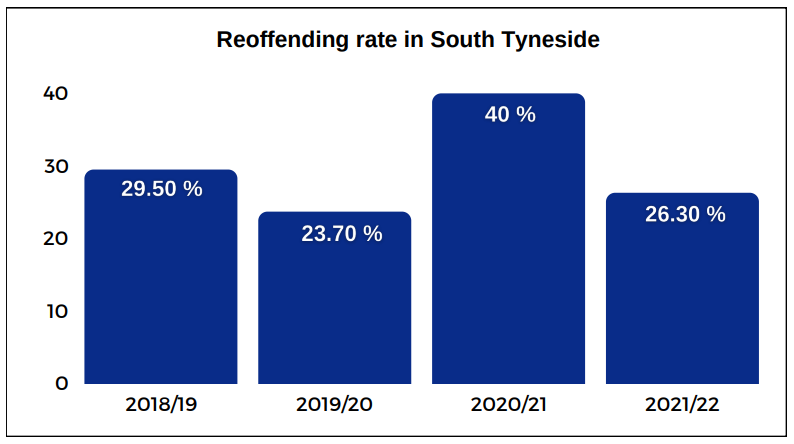
| Reoffending rate in South Tyneside | |
|---|---|
| 2018/19 | 29.5% |
| 2019/20 | 23.7% |
| 2020/21 | 40% |
| 2021/22 | 26.3% |
This also compares favourably with reoffending rates regionally and nationally over the same period as shown below. This data is based on the percentage of children involved with the YJS who go on to commit further offences and is taken from the Police National Computer (PNC).
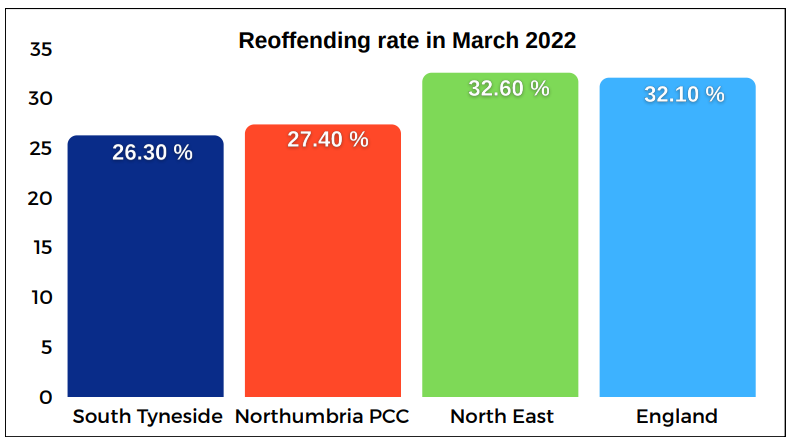
| Reoffending rate March 2022 by comparison | |
|---|---|
| South Tyneside | 26.3% |
| Northumbria PCC | 27.4% |
| North East | 32.6% |
| England | 32.1% |
The data below shows the number of First Time Entrants (FTEs) for the YJS between 2019-2023/24. An FTE is a child who has received a substantive outcome for a proven offence. This includes Youth Cautions, Youth Conditional Cautions, Referral Orders, Youth Rehabilitation Order or a custodial sentence. These specific disposals are used by police or the Court, in conjunction with a YJS recommendation, for offences where it is not possible to divert the child from the formal youth justice system.
The data shows a reduction in the number of FTEs from the previous year, indicating greater use of diversionary disposals with a downward trajectory since 2019/20.
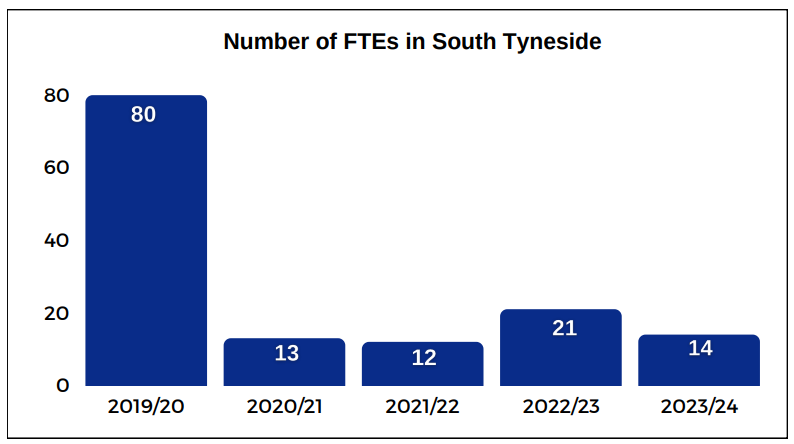
| Number of First Time Entrants in South Tyneside 2019-2024 | |
|---|---|
| 2019/20 | 80 |
| 2020/21 | 13 |
| 2021/22 | 12 |
| 2022/23 | 21 |
| 2023/24 | 14 |
South Tyneside FTEs rates are lower than the North East and National rate, although slightly higher than the Northumbria Police Force. The rate is calculated per 100,000 of the population entering the youth justice system for the first time.
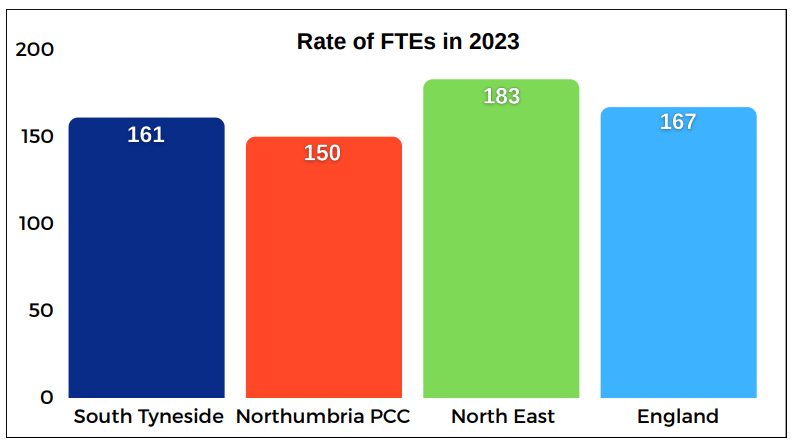
| Number of First Time Entrants by comparison | |
|---|---|
| South Tyneside | 161 |
| Northumbria PCC | 150 |
| North East | 183 |
| England | 167 |
In March 2023 the YJS had one child remanded to Youth Detention Accommodation, currently awaiting trial. In the previous 5 years there were no children in custody, indicating an absence of serious offences committed by children in the borough and good use of alternative community sentences.
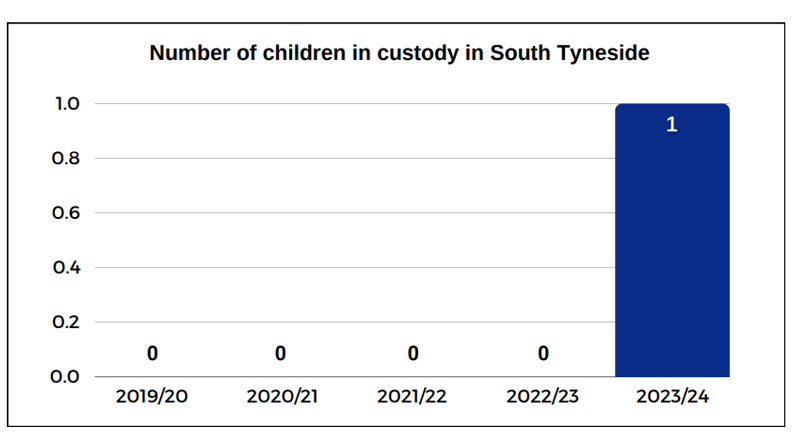
| Number of children in custody in South Tyneside 2019-2024 | |
|---|---|
| 2019/20 | 0 |
| 2020/21 | 0 |
| 2021/22 | 0 |
| 2022/23 | 0 |
| 2023/24 | 1 |
The rate of custody, per 1000 of the 10–17-year-old population continues to remain extremely low and lower than the regional and national rate as shown below.
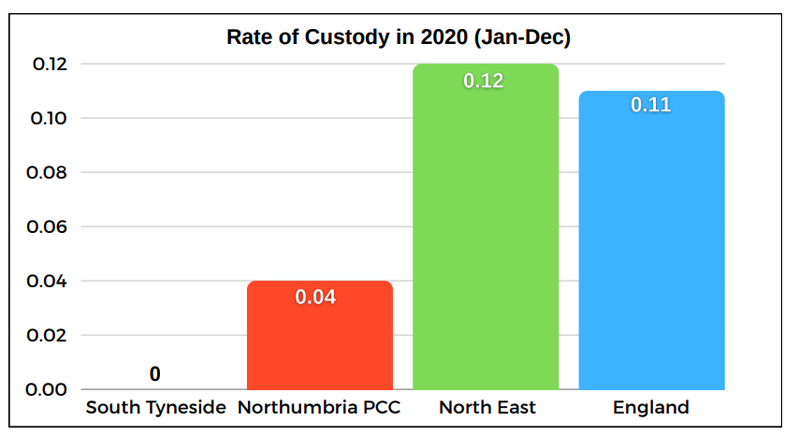
| Custody rate by comparison in 2020 | |
|---|---|
| South Tyneside | 0 |
| Northumbria PCC | 0.04 |
| North East | 0.12 |
| England | 0.11 |
Over-represented groups
The YJS monitor and report on a range of data, including demographic data to analyse and understand the background of the children it supports. The table below shows the number and percentage of children open to YJS over the past 5 years who have had an Education, Health and Care Plan.
| Children with (EHCP) | ||||||||
|---|---|---|---|---|---|---|---|---|
| 2020/21 | 2021/22 | 2022/23 | 2023/24 | |||||
| Total | % | Total | % | Total | % | Total | % | |
| EHCP | 4 | 2% | 6 | 3% | 4 | 1.6% | 19 | 12% |
| Total YP open to YJS | 192 | 207 | 240 | 154 | ||||
The data below shows the number and percentage of children open to the YJS who were either cared for, child protection or child in need at the end of their intervention. In the past year 24% of children were open to Children’s Social Care in some capacity.
| Children’s social care status | ||||||||
|---|---|---|---|---|---|---|---|---|
| 2020/21 | 2021/22 | 2022/23 | 2023/24 | |||||
| Total | % | Total | % | Total | % | Total | % | |
| Cared for | 3 | 1.5% | 6 | 3% | 16 | 6.5% | 13 | 8% |
| CP | 3 | 1.5% | 4 | 2% | 15 | 6% | 7 | 4.5% |
| CIN | 4 | 2% | 5 | 2.5% | 1 | 1% | 18 | 11.5% |
| Total YP open to YJS | 192 | 207 | 240 | 154 | ||||
| Involvement with Early Help | ||
|---|---|---|
| 2023/24 | ||
| Total | % | |
| Total YP open to Early Help prior to YJS involvement | 10 | 6% |
| Total YP who became open to Early Help whilst working with YJS | 3 | 2% |
| Total YP open to Early Help | 13 | 8% |
| Total YP open to YJS | 154 | |
The data below shows the ethnicity of the children open to YJS over the last 4 years. In the last year 95% of children were from a white British background.
| Ethnicity | ||||||||
|---|---|---|---|---|---|---|---|---|
| 2020/21 | 2021/22 | 2022/23 | 2023/24 | |||||
| Total | % | Total | % | Total | % | Total | % | |
| BAME | 6 | 4% | 18 | 9% | 16 | 7% | 8 | 5% |
| White British | 186 | 96% | 214 | 91% | 224 | 93% | 146 | 95% |
| Total YP open to YJS | 192 | 207 | 240 | 154 | ||||
The data below shows the breakdown of children open to YJS by sex.
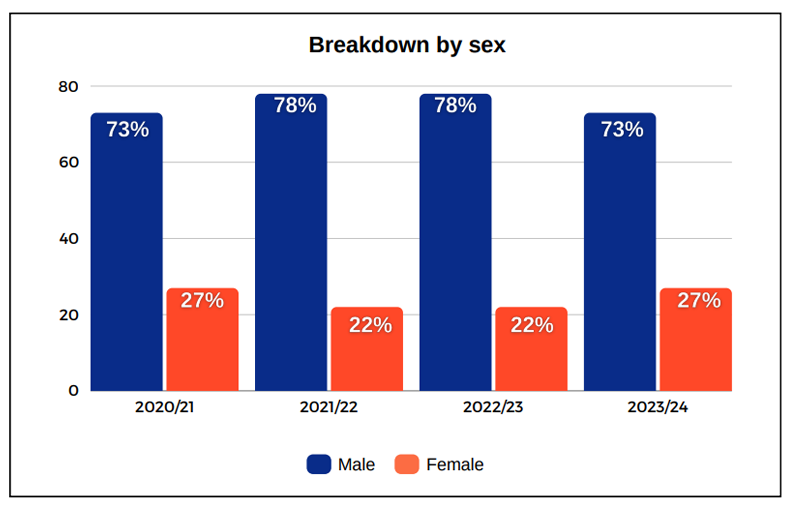
| Breakdown by sex | ||||||||
|---|---|---|---|---|---|---|---|---|
| 2020/21 | 2021/22 | 2022/23 | 2023/24 | |||||
| Male | 73% | 78% | 78% | 73% | ||||
| Female | 27% | 22% | 22% | 27% | ||||
In April 2023 10 additional KPI’s were introduced. The new KPIs and a comparison with regional and national data from Q3 (Oct-Dec 2023) are set out below:
KPI 1 - Proportion of children who were in suitable accommodation at the end of their order
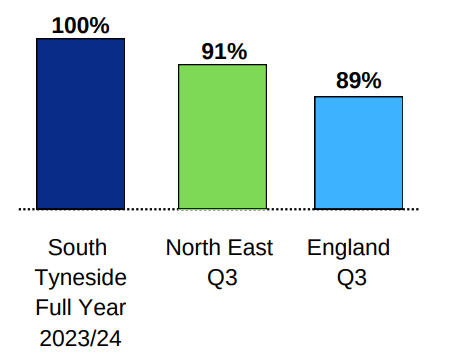
| South Tyneside Full Year 2023/24 | 100% |
|---|---|
| North East Q3 | 91% |
| England Q3 | 89% |
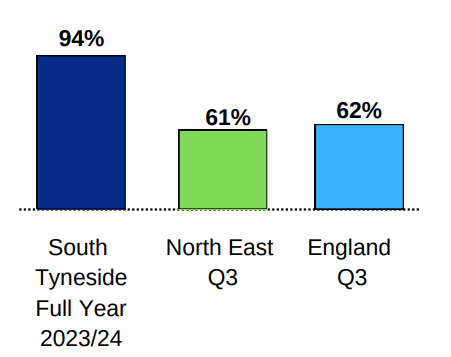
KPI 2 - Proportion of children who were in suitable EHE institution at the end of their order
| South Tyneside Full Year 2023/24 | 94% |
|---|---|
| North East Q3 | 61% |
| England Q3 | 62% |
KPI 3 - Number of children with an EHCP in place as a proportion of those with an identified SEND/ALN
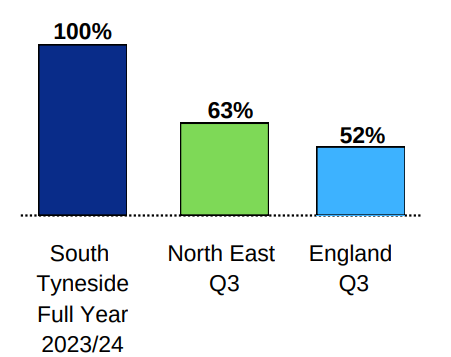
| South Tyneside Full Year 2023/24 | 100% |
|---|---|
| North East Q3 | 63% |
| England Q3 | 52% |
KPI 4 - Number of children with a screened or identified need for an intervention to improve mental health.
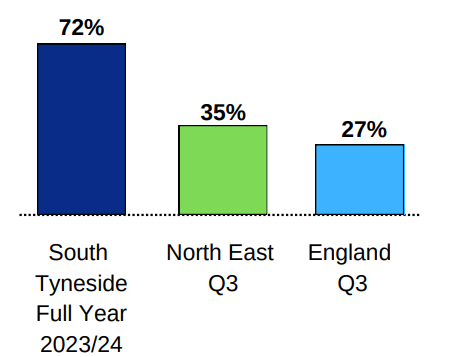
| South Tyneside Full Year 2023/24 | 72% |
|---|---|
| North East Q3 | 35% |
| England Q3 | 27% |
KPI 5 - Number of children with a screened or identified need for intervention or treatment for substance misuse.
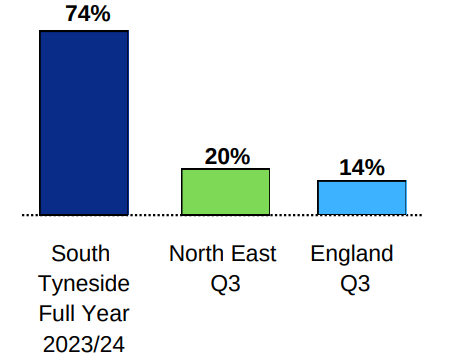
| South Tyneside Full Year 2023/24 | 74% |
|---|---|
| North East Q3 | 20% |
| England Q3 | 14% |
KPI 6 - Number of children who completed intervention programmes in the quarter as a % of all OOCD cases
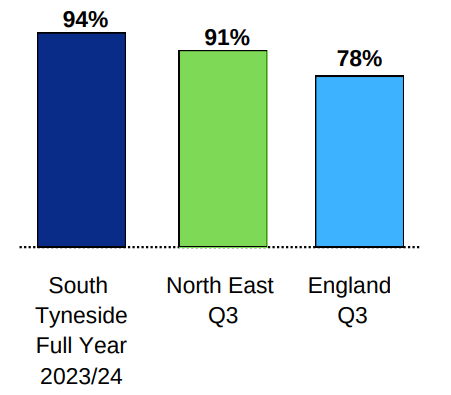
| South Tyneside Full Year 2023/24 | 94% |
|---|---|
| North East Q3 | 91% |
| England Q3 | 78% |
KPI 7 - Proportion of children connected to or supported by wider care and support services at the end of order
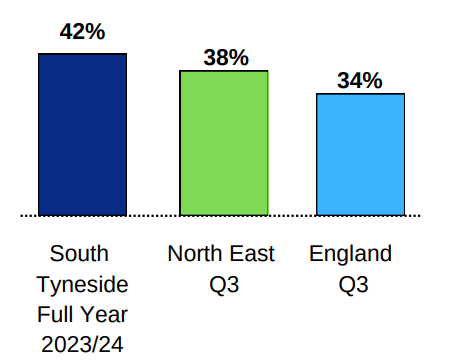
| South Tyneside Full Year 2023/24 | 42% |
|---|---|
| North East Q3 | 38% |
| England Q3 | 34% |
KPI 8 - Number of senior partners attending Management board meetings
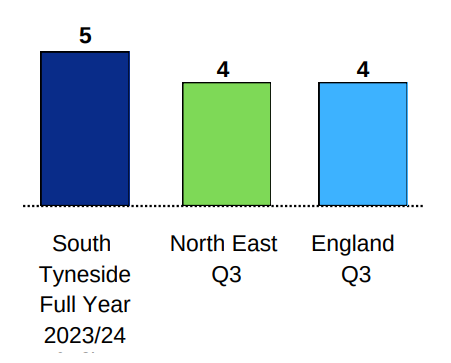
| South Tyneside Full Year 2023/24 | 5 |
|---|---|
| North East Q3 | 4 |
| England Q3 | 4 |
KPI 9 - Number of proven serious violence offences as a rate per 100 of 10-17 population (2021)
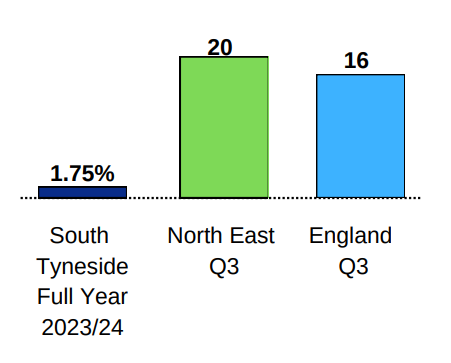
| South Tyneside Full Year 2023/24 | 1.75% |
|---|---|
| North East Q3 | 20 |
| England Q3 | 16 |
KPI 10 - The number of victims engaged in restorative justice opportunities as a proportion of the total number of victims who consented to engage with the YJS.
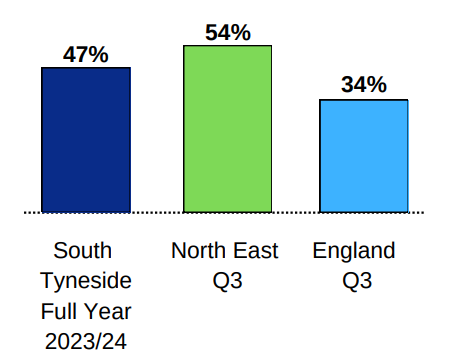
| South Tyneside Full Year 2023/24 | 47% |
|---|---|
| North East Q3 | 54% |
| England Q3 | 34% |
Risks and Issues
The cost of living is rising rapidly in South Tyneside and is having a significant impact on our families. As we continue to recover from longer term disruptive impact of the Covid pandemic and manage a cost-of-living crisis, the challenges facing young people and families becomes increasingly evident. As partners, we are working hard to support families that have been adversely affected by these unprecedented events in recognition of the correlation between poverty and offending.
The links between poverty and offending is well understood as is the inequalities that exist in South Tyneside impacting on levels of social exclusion, a rise in acquisitive crime and/or a sense of injustice and empowerment. All factors are likely to impact on health, wellbeing and reduce opportunities for children, young people and families.
As partners we continue to ensure a multi-agency focus on the development of working together to put measures in place to respond to children, young people and family’s needs, ensuring a collaborative approach.
In South Tyneside we recognise the links between poverty, serious youth violence, criminal and sexual exploitation, and any potential emerging gang culture. The partnership remains focused to become more preventative in our responses with clear referral pathways to support services.
The Turnaround programme funded through the Ministry of Justice has supported prevention and diversion in the service, however the programme is to end in March 2025 leaving a gap in targeted prevention delivery and potential capacity issues. There continues to be ongoing financial pressure on the council and other public services in addition to inflation and uncertainty in terms of reduction in public sector finances inclusive of the Youth Justice Grant, that may create additional pressure.
As part of our strategy to manage risks to future service delivery in an uncertain financial climate, the YJS work collectively as a Family Help and Adolescent Services portfolio to pool resources, and within the Supporting Families programme there is criteria to prevent crime, tackle crime and keep children safe from exploitation.
As a small borough South Tyneside continues to build on our strong multi-agency partnerships utilising innovative ways of working. We are driven and committed to collectively doing our best for the communities we serve improving the outcomes for children, young people and families.
Plan for Forthcoming year
Child First
South Tyneside YJS is committed to a Child First approach and have worked extensively to embed this principle into every aspect of the work we do. Through this approach we recognise that children and young people have different needs and unique circumstances which requires early intervention, diversion, and rehabilitation to achieve the aim of preventing offending and re-offending.
All staff at South Tyneside YJS are introduced to the Child First principle as part of a staff induction and to further embed this in practice all staff have completed the Child First Effective Practice Award programme or are in the process of doing so. The theoretical knowledge and learning gained through completing the programme is now applied across the service.
The YJS and The Board advocate strongly for the 4 Child First tenets identified by the YJB:
| SEEING CHILDREN AS CHILDREN | BUILDING PRO-SOCIAL IDENTITY | COLLABORATING WITH CHILDREN | DIVERTING FROM STIGMA |
|---|---|---|---|
| Prioritise the best interests of children and recognising their needs, capacities, rights and potential. All work is child focused, developmentally informed, acknowledges structural barriers and meets responsibilities towards children. |
Promote children’s individual strengths and capacities to develop their pro-social identity for sustainable desistance, leading to safer communities and fewer victims. All work is constructive and future focused, built on supportive relationships that empower children to fulfil their potential and make positive contributions to society. |
Encourage children’s active participation, engagement and wider social inclusion. All work is a meaningful collaboration with children and their carers. | Promote a childhood removed from the justice system, using pre-emptive prevention, diversion and minimal intervention. All work minimises criminogenic stigma from contact with the system. |
Being Child First involves hearing the voice of the child and in South Tyneside we capture this in several ways including, service user feedback, participation groups and attendance at The Board.
To provide more quantitative data the YJS has analysed feedback forms from 52 children in 2023-24.
The data shows that the most common response to the question of “What was most helpful about YJS?” was the intervention and work around consequences. This may not necessarily have been what the children enjoyed most, but it is what most children found was helpful for them. Encouragingly, the second most common answer relates helpful staff which indicates good relationship building and staff willing to provide help and support.
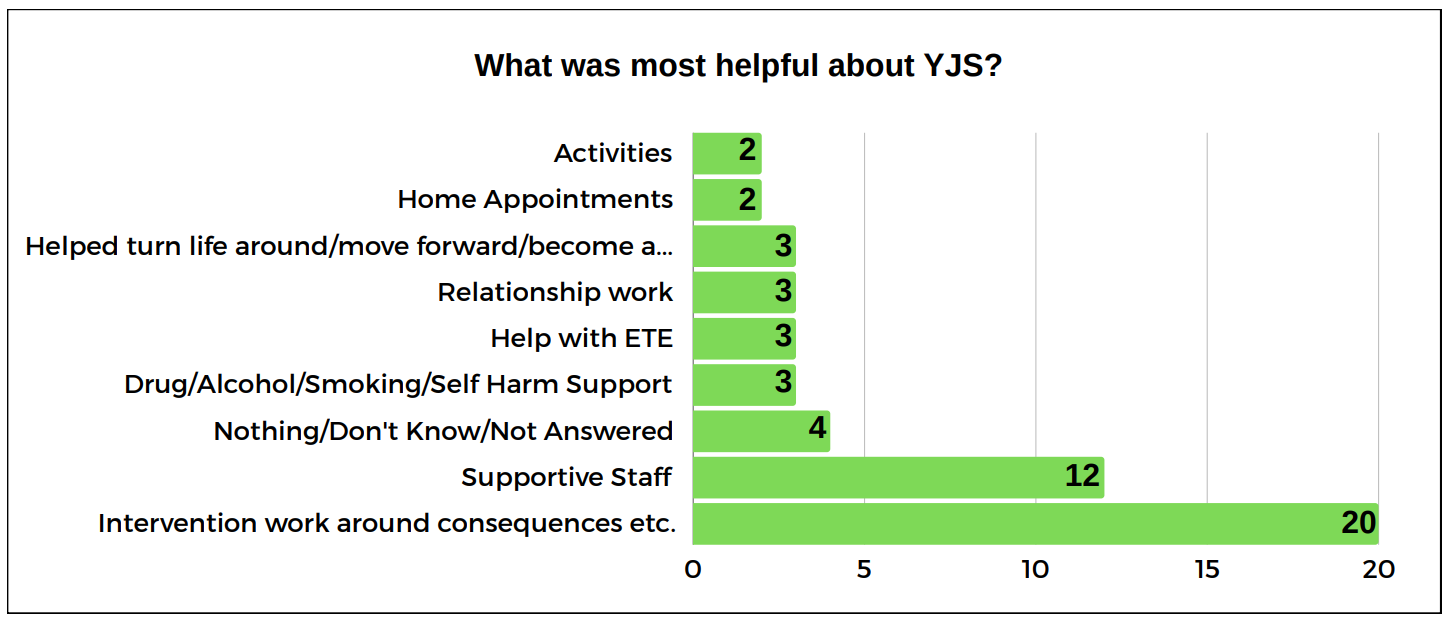
| What was most helpful about YJS? | |
|---|---|
| Statement | Nomber of people |
| Activities | 2 |
| Home Appointments | 2 |
| Helped turn life around/move forward/ become a... | 3 |
| Relationship work | 3 |
| Help with ETE | 3 |
| Drug/Alcohol/Smoking/Self Harm Support | 3 |
| Nothing/Don't know/Not answered | 4 |
| Supportive Staff | 12 |
| Intervention work around consequences etc. | 20 |
Similarly, the most common answer to the question “What did the YJS do well?” was related to intervention work with the second most common answer being good communication.
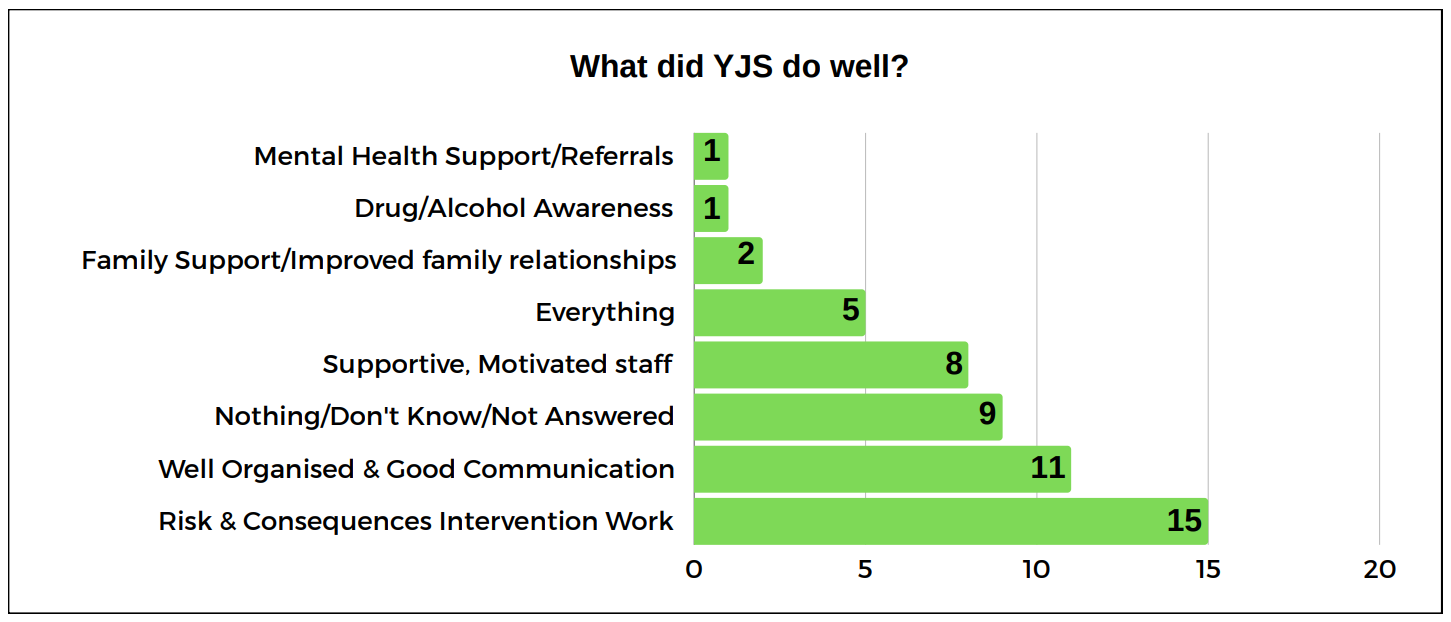
| What did YJS do well? | |
|---|---|
| Statement | Number of people |
| Mental Health Support/Referrals | 1 |
| Drug/Alcohol Awareness | 1 |
| Family Support/Improved family relationships | 2 |
| Everything | 5 |
| Supportive, Motivational stff | 8 |
| Nothing/Don't Know/Not Answered | 9 |
| Well organised & Good Communication | 11 |
| Risk & Consequences Intervention Work | 15 |
In terms of what is least helpful the data shows that children often struggled to articulate what they found least helpful and would perhaps benefit from support in identifying this.
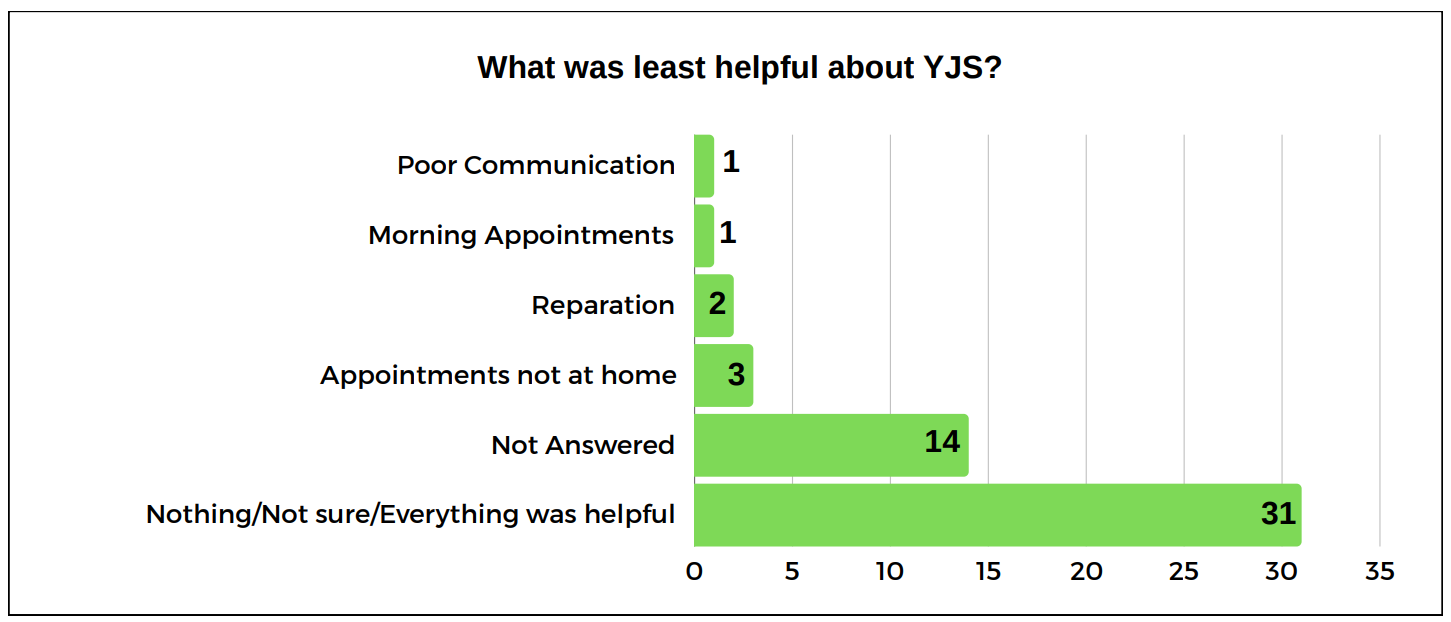
| What was least helpful about YJS | |
|---|---|
| Statement | Number of people |
| Poor communication | 1 |
| Morning Appointments | 1 |
| Reparation | 2 |
| Appointments not at home | 3 |
| Not answered | 14 |
| Nothing/Not sure/Everything was helpful | 31 |
In 2024/25 the YJS intend to explore more creative ways to gather feedback including the possibility of considering using a children’s voice app and digital feedback tools.
It was a really good vibe and I learned a lot about the outside world. It's not like school at all and you do not get treated like a baby.
Resources and Services
The YJB Grant is utilised in accordance with the conditions stipulated in the Youth Justice Grant Agreement. Details of income and expenditure for the period 2023/24 notes the contribution from the YJB, Local Authority and the benefits in kind from partner agencies (see Appendix 2).
The Probation Service provide a seconded Probation Officer (0.8 FTE) and the YJS Team Manager provides daily oversight. To maintain strong working links with Probation Service the YJS Team Manager and the Probation Service Team Manager meet on a quarterly basis for case discussions and performance management regarding transitions.
The Probation Officer manages all cases which will be transitioned to the National Probation Service to ensure consistency and to make use of knowledge and skills in managing adult offenders.
Northumbria Police provide two seconded Police Officers (1.7 FTE) which allows for direct partnership working between the 2 agencies. This relationship is essential in the effective delivery of services, particularly regarding Out of Court Disposals which in 2023/24 made up 88% of statutory YJS work. Police attend the Out of Court Disposal panel each week and contribute to the agreed outcome. They subsequently deliver the disposal to the young people and can offer additional monitoring and oversight for young people who require a more intensive level of intervention.
The Out of Court Disposal Panel also includes colleagues from Early/Family Help, the Virtual School, Matrix Substance Misuse Service as well as colleagues from Children’s Social Care, allowing the YJS to access a range of services and resources.
Wider partnership work with Northumbria Police is in place to minimise detention in custody for young people through the Operation Harbinger protocol and through delivering specific intervention in areas such as knife crime and motoring offences. The force also delivers wider education work within schools across the region highlighting the dangers of knives and weapons.
Although there is no formal protocol in place, the YJS benefits from mental health resources provided by colleagues from the Cumbria, Northumberland, Tyne and Wear (CNTW) NHS Foundation Trust. This involves consultation and intervention directly with children and families where appropriate.
Board Development
Following changes in the board membership, South Tyneside YJS held a Board Development Session on the 16th of June 2023, this was facilitated by the Director of Operations, North and Midlands Regional Youth Justice Board. In presenting the Youth Justice Service governance and leadership guidance, the session focused on providing members with an induction into the role and responsibilities of members at the board and in their respective organisations.
We have further developed The Board induction process to ensure effective relationships between the members, YJS staff and volunteers. In line with the YJB key performance indicators, the YJS will record attendance of partners ensuring appropriate seniority and representation. Board meetings take place face to face to ensure greater visibility and relationship building across the partnership, hybrid options also take place when deemed appropriate for attendance. Staff are invited to attend The Board to showcase their work with young people and families. This ensures members have a good operational understanding of the service while developing relationships and connectivity between operational staff and strategic leaders.
Workforce Development
The YJS recognises the importance of a skilled, knowledgeable, and motivated workforce and has a culture of continuous professional development. This year we have developed a Workforce Strategy which identifies training priorities for the service for 2024-2026.
All YJS staff receive a detailed induction and mandatory training on the use of case management systems, safeguarding, Prevent Duty and information and data management.
The wider training offer includes the South Tyneside Council’s corporate induction with a focus on the overall vison, values and strategy of the council as well as additional mandatory training identified in South Tyneside Safeguarding Children Partnership training programme.
Development routes for staff include the Youth Justice Effective Practice Award with 93% of staff having completed this. Many have also gone on to complete a degree in Youth Justice, further enhancing their development.
Additional opportunities include apprenticeship programmes, specifically in youth justice or management, and there are currently three staff enrolled on apprenticeships. Other staff members will be given similar opportunities on a rolling basis to ensure there is no adverse impact on service delivery.
The YJS invests in training of leaders with the operational level managers within YJS having completed Youth Justice Sector Improvement Partnership (YJSIP) Operational Manager Course. There is also the opportunity for one manager to complete the Elevate Mentoring Programme at a future date. Furthermore, two managers have completed the Aspiring Future Leaders course delivered by the Association of Youth Justice Managers.
Annual appraisals and regular supervision assist in supporting the strengths of staff, giving opportunities to provide constructive feedback and to identify areas where staff wish to develop and improve their practice as part of continuous professional development.
All volunteers at YJS are required to undertake level 2 safeguarding, child exploitation and Prevent Duty training with volunteer panel members also required to complete specific panel member and restorative justice training.
Evidence Based Practice and Innovation
The YJS uses evidence-based practice and innovative ways of working, recognising the need for creativity when working with children who may have encountered Adverse Childhood Experiences. Examples of programmes undertaken by children include:
Violence Reduction Unit (VRU) sports-based intervention
The YJS and South Tyneside Youth Services have provided on-going sports-based interventions funded through the VRU.
These activities include climbing, surfing, football, gym, and mixed martial arts sessions. The gym and mixed martial arts activities encourage self-awareness and wellbeing with a focus on healthy lifestyles and promote positive to life choices. In 2023-24 forty-three children open to the YJS accessed the gym and mixed martial arts. The impact of these sessions is described by the young people in these short videos: VRU Seasonal Violence Fund - YouTube
Connor Brown Trust
In 2023 the YJS partnered with the Connor Brown Trust to deliver knife crime awareness sessions to children. Connor Brown was a young man who was killed in a knife related incident in nearby Sunderland. His parents, Tanya and Simon, have delivered powerful intervention to children open to the YJS. This will continue throughout 2024 and beyond.
NECA Community Garden
The YJS has partnered with the award winning NECA Community Garden to give children open to YJS access to activities related to gardening, horticulture, and woodwork. Children can access this resource to promote and develop aspirations they may have for employment in any of these areas and as a way of completing reparation and making amends to the community. Children who have participated in this have developed their knowledge and practical skill and have been able to appreciate the therapeutic benefits of working with nature.
Cookery
The YJS Restorative Justice Officer established victim awareness related cookery sessions to enable the delivery of intervention in a non-threatening and imaginative way, whilst giving children skills which they can use beyond their involvement with YJS. This has been developed further by other staff and is now used more widely as a means of promoting engagement and delivering strengths-based intervention and practical skills for independent living.
Girls Group
In 2023 the YJS established a groupwork programme to deliver intervention and education to girls involved with the YJS. The programme involves 6 sessions looking at areas such as healthy relationships, exploitation, drug and alcohol awareness, sexual heath and perception of self and others, all of which are areas which can be linked to risk of reoffending and safety.
Do it Profiler
The YJS continues to use the Do it Profiler tool to help identify neurodiversity difficulties which may require a professional assessment. In 2023- 24 fourteen young people agreed to complete the Do it Profiler with results helping the children and professionals understand and adapt to their individual needs.
YOLO (You Only Live Once)
The YOLO project is a 20-week early intervention programme aimed at children aged 10-16 who have been or at risk of becoming involved in knife crime or serious violence. It is delivered by the Foundation of Light, a charity linked to Sunderland Association Football Club using football as a means of diverting children away from serious violence. The YJS can make referrals directly to YOLO and in 2023-24 eleven referrals were made to the project.
Evaluation
In 2023 the YJS partnered with the Northeast Local Enterprise Partnership (LEP) to pilot a mentoring program which matched local employers with year 11 children to help improve their knowledge and understanding of a working environment.
The volunteer mentors were recruited through South Tyneside Council’s Economic Inclusion Team and trained and matched with children. Mentors acted as positive role models and offered opportunities for the children to visit workplaces and help them understand what is required to achieve employment in their area of expertise.
Feedback from the children and mentors showed that all involved benefitted and the pilot concluded with a celebration event held at the Town Hall in January 2024. One child involved also attended The Board, along with his mentor, to describe his experience.
The full evaluation of the pilot can be found here: Evaluation of the North East LEP and South Tyneside Youth Justice Service Mentoring Programme - North East Evidence Hub
Although the funding was limited to the initial pilot, the YJS intends to roll this out again in the coming year to allow other children the opportunity of experiencing work related mentoring. We also intend to expand the programme to maximise participation.
In July 2024 the YJS will be part of Northumbria Police Force’s review of Out of Court Disposals. The review is being conducted by Rocket Science, a policy and research organisation who specialise in social care and criminal justice. The intention is to review practice across the 6 Youth Offending Teams who operate in the Northumbria Police area to evaluate good practice and areas for improvement.
Priorities for the Coming Years
Standards for Children
The Standards for Children in the Youth Justice System (2019) document defines a minimum expectation for all agencies that provide statutory services to ensure good outcomes for children in the youth justice system. Standards for children in the youth justice system 2019.
In October 2023 the YJS completed a self-audit of National Standard 2: At court.
The audit consisted of three sections. Section A focused on strategic performance whilst sections B and C looked at practice. In section A the YJS scored as either Good or Outstanding in all areas with one exception related to promoting fair treatment of over-represented children.
The audit did not find any examples of unfair treatment, however further work was required to ensure that staff had a better understanding of national data, patterns and trends which show that some groups are over–represented in the court and custodial setting. This has now been achieved through staff training and will be further enhanced with the recruitment of a Speech and Language Therapist.
Sections B and C similarly resulted in mostly Good or Outstanding ratings, but areas which did require improvement highlighted the lack of explicit recording of interaction with children and families at court.
The results of the audit were included in the Service Improvement Plan and actions have now been taken to ensure all areas can move towards outstanding practice in future audits.
Service Development
The most recent HMIP inspection was conducted in October 2020 and the report published in February 2021. The overall rating of the YJS at that time was ‘Requires Improvement.’ The key recommendations from this inspection were as follows:
- Take steps to improve planning for safety and wellbeing and risk of harm to others, including contingency arrangements.
- Review the risk and needs of children at regular intervals and when there is a significant change.
- Provide consistent management oversight that is effective in improving practice.
- Improve knowledge and understanding of the roles and responsibilities between management board and staff.
- Review the decision-making process for out-of-court disposals to make sure safeguarding issues are identified and responded to as needed.
An Improvement Plan was initially published in March 2021 and was regularly reviewed by The Board. Significant progress has been made against the recommendations and The Board has agreed any further service improvements will be reviewed by exception.
The Improvement Plan included the need for additional staff training, this resulted in further investment in staff training and development for YJS staff in 2023.The training programme consisted of Risk Training, Child First Effective Practice Award, Trauma Informed Practice training, and Unconscious Bias.
In addition to staff development, the quality assurance and audit processes have also been improved to ensure risks and strengths are appropriately identified and that plans are collaborative, inclusive, and deliverable.
The appointment of a permanent YJS Manager and two newly appointed Senior Practitioners brought stability and consistency to the management team within the service.
Face to face team meetings are held monthly with a full team development day planned for September 2024. The development day will further review practice and begin preparation for the implementation of the new HMIP Inspection Framework in 2025.
The Youth Justice Oversight Framework was launched in 2023 and categorises YJS’ into 1 of 4 potential quadrants, based on performance. The YJS welcomed the opportunity for collaborative working with the Youth Justice Board and has been placed in Quadrant 2, demonstrating satisfactory performance.
The YJS has requested a Peer Review from the Youth Justice Sector Improvement Partnership (YJSIP) to obtain an objective view on areas of practice to maintain continuous service development and improvement. The review will be undertaken in September 2024.
National Priority Areas
Children from Groups which are Over-Represented
The performance data shows that in 2023/24 the YJS statutory caseload was 77% male and 23% female, with the female representation being above the national average. The average was adversely affected by a spike in the months of November, December and January and resulted in a review into the increase of girls open on a statutory basis, concluding that although there was no one event that had caused the increase, the spike did include a high number of girls involved in violent offences against other girls. The findings were presented at The Board to support a partnership approach to this issue.
In recognition the increasing number of girls open to the YJS, a girls group was established. This was a 6-week programme delivering educational work on topics specific to girls and which can be factors in offending. The data on over-representation of girls continues to be monitored monthly and the YJS will respond to any further trends.
The YJS continues to produce an annual Offending Behaviour and Ethnicity Report which is presented to The Board. The most recent report was produced in December 2023 and analysed offending by 226 children over a 12-month period. Of those children, 94% identified as white British. The report found no evidence of disparity in outcomes or any indication of conscious or unconscious bias.
The YJS remains alert to the barriers faced by children from over-represented groups and continue to assess and respond to diversity, in all its forms.
Policing
South Tyneside YJS operates within the Northumbria Police Force area who established a Prevention Department in October 2023 with a view to creating a more cohesive and structured preventative approach to the Force. The department was specifically designed to merge several key roles/portfolios of prevention work, which had previously been completed in isolation. This included the oversight and management of the dedicated Youth Justice Service Police Constables.
The department has adopted the National Prevention Strategy, the strategic aim is to have fewer victims, fewer offences, and less demand on policing. This will be achieved by addressing the causes of crime, utilising sophisticated partnership problem solving with a focus on Reducing Offending, Reducing Harm and Reducing Demand. The Force will adopt a culture change, ensuring that preventative policing is embedded as a core function to maximise opportunities for collaborative approaches.
Challenges or Risks
- Violent offences and addressing this with effective and proportionate outcomes.
- Young people’s use and misuse of technology, ensuring that our officers and YJS staff have the skills to understand and address any offending.
- Continued social and economic factors impacting our young people and the possible consequence on offending.
Prevention and Diversion
The YJS has a long-established prevention offer to work with children who are at risk of offending and anti-social behaviour. Referrals are received from partners including schools, police, Social Care and Family Help and Adolescent Services. In 2023-24 the YJS received 52 prevention referrals, an increase of 18 from the previous year.
The introduction of the Ministry of Justice’s Turnaround Programme in 2023 has allowed us to expand this offer to support additional numbers of children at risk of offending or involved in anti-social behaviour.
109 children have been offered support through the Turnaround Programme in 2023/24. The YJS remains on track to deliver intervention to 97 children across the duration of the programme. Of those who have successfully complete the programme, none have gone on to commit an offence resulting in a judicial outcome or a youth caution/conditional caution, highlighting the value that early intervention has.
Exit and succession planning is in place for the Turnaround Programme ending in March 2025. We will use the lessons learned from the evaluation (when published) to inform our prevention work in Family Help and Adolescent Services.
YJS continues to work with partners from Northumbria Police to divert children from the formal youth justice system using a deferred prosecution known as Outcome 22. Children who are given an Outcome 22 still receive an assessment and intervention, but they do not become a First Time Entrant.
The Divert from Charge initiative introduced by Northumbria Police involves a panel considering whether children, who would ordinarily be charged with an offence, based on the gravity score and other factors, could still be diverted through the Out of Court Disposal process.
Education
It is well documented that when a child is invested in education, training, or employment they are more likely to live a life free of offending. The YJS is committed to ensuring young people have opportunities to participate fully, and to the best of their ability, in education, training and employment.
We believe involvement in offending should not be a barrier for any child from achieving their potential, and we work closely with partners to remove any disadvantage.
All staff are committed to promoting attendance in education and where additional support is required, the YJS has a specialist Education Training and Employment worker who has and an in-depth knowledge of the education system.
The Board has representation from partners in education, including the Head of Learning and Early Help and the Head of the alternative education provider. This allows for strategic level discussions around potential barriers to young people accessing education.
In 2023 the YJS Manager established monthly meetings with the Head Teacher from the Borough’s Pupil Referral Unit to improve working relationships and break down any potential barriers to education. This has resulted in the YJS facilitating ways to provide education to some children who otherwise would have missed out on opportunities due to their offending.
The YJS has sought to establish closer working relationships with mainstream schools to promote the prevention offer to children who are at risk of permanent exclusion though persistent disruptive behaviour. The YJS recognises the harm that permanent exclusion can do to a child and understand that behaviours displayed in school may be replicated at home or in the community. We know that children who are permanently excluded are more likely to offend. In 2024-25 the YJS will continue to promote closer working relationships with mainstream schools by having an allocated Single Point of Contact (SPOC) for all secondary schools in the borough, and they will work with the Early Help SPOCs already in place within all schools.
The YJS has also worked collaboratively with the Safeguarding Children Partnership and the VRU to produce a regional protocol for schools to respond to children in possession of weapons in school. The protocol will provide a consistent and timely response to incidents in schools avoiding, where possible, children being permanently excluded. The protocol can be viewed here: Offensive Weapon and Knife Carrying Protocol for South Tyneside (PDF)
Restorative approaches and victims
The YJS continues to work hard to promote the use of restorative justice wherever possible and to provide support to victims of crime. The introduction of the victim related KPI and the inclusion of a victim focused domain in the new HMIP inspection framework has added additional importance to this area of work.
Of the responses received, there was a 100% satisfaction rate with the service offered. In the coming year the feedback system will be enhanced to improve the level of victim responses and inform service development.
In the year 2023/24, the YJS received 108 victim referrals linked to 99 Out of Court Disposals and 9 Referral Orders cases. This is an increase from the previous year of 107%.
| Quarter 1 (Apr-Jun 2023) |
Quarter 2 (July-Sept 2023) |
Quarter 3 (Oct-Dec 2023) |
Quarter 4 (Jan-Mar 2024) |
Total | |
|---|---|---|---|---|---|
| Total number of victim referrals | 20 | 25 | 35 | 28 | 108 |
| Out of court disposals | 18 | 23 | 30 | 28 | 99 |
| Referral Orders | 2 | 2 | 5 | 0 | 9 |
Of the 108 referrals received, there were 78 individual victims consisting of 50 females and 28 males, with females almost twice as likely to be a victim than their male counterparts.
The data below shows that there were 50 corporate victims referred during the reporting period. These mostly consisted of offences committed on Metro system or against NEXUS, towards officers of Northumbria Police and several local shops.
The data also shows that those under the age of 18 were most likely to be victims of crime themselves highlighting the vulnerability of children to offending from other children. Of the 23 under 18s who were victims of crime, 16, or 70% were victims of violence from peers. 11 of these victims were female and 5 were male.
| Victim Profiling | |||||
|---|---|---|---|---|---|
| Quarter 1 (Apr-Jun 2023) |
Quarter 2 (July-Sept 2023) |
Quarter 3 (Oct-Dec 2023) |
Quarter 4 (Jan-Mar 2024) |
Total | |
| Individual victims | 17 | 17 | 29 | 15 | 78 |
| Corporate victims | 3 | 8 | 6 | 13 | 30 |
| Number of female victims | 10 | 11 | 20 | 9 | 50 |
| Number of male victims | 7 | 6 | 9 | 6 | 28 |
| Age bracket | Total number of victims |
|---|---|
| 18 and under | 23 |
| 20-29 | 10 |
| 30-39 | 9 |
| 40-49 | 17 |
| 50-59 | 10 |
| 60+ | 9 |
Within the last twelve months there have been 32 restorative justice interventions, 4 of which were direct to the victim. There have been 28 indirect restorative interventions consisting of 15 sessions of shuttle mediation and 13 letters of apology/explanation. In addition, 116 direct victim awareness sessions were delivered over the last year by the Restorative Justice Worker.
Case Study: Restorative Justice
A referral was received into the service for a 16-year-old male, Charlie* who had been arrested by police for committing criminal damage within the family home. This led to the breakdown of his mother’s relationship with him, resulting in Charlie no longer being able to live with his mother Sarah* and moving in with his grandparents.
A victim referral was received for Sarah and a home visit undertaken to allow her to express her views and explore any support needed. Sarah shared a significant domestic abuse history spanning 20 years perpetrated by her ex-partner, the father of Charlie, and she shared that Charlie had started to exhibit behaviour similar to that of his father. This had triggered her feelings of trauma and fear and she felt she was “walking on eggshells” within her own home. Sarah shared that Charlie had been verbally aggressive and physically violent towards her in the past and she was scared this would happen again.
The Restorative Justice (RJ) Officer utilised her specialist training to sensitively discuss the extent of the domestic abuse Sarah had suffered, including current and historic abuse. This information was used to complete a DASH risk assessment to determine levels of risk, support needs and safety planning for Sarah. Sarah asked for a referral to be made for specialist counselling and asked for fortnightly contact to regularly check-in with her for the duration of Charlie’s Out of Court Disposal. This enabled the RJ Officer to monitor the situation and revisit the DASH risk assessment and escalate if needed.
Sarah benefited from regular contact with the RJ Officer, providing her with an outlet for her voice to be heard and to validate her experiences as a victim. Sarah was referred for specialist counselling and she reports to have greatly benefited from this. The RJ Officer and Charlie’s YJS Case Manager worked together to ensure support and intervention was delivered to both Charlie and Sarah, with regular communication to keep each other updated. This also included liaison with Children’s Social Care and involvement from additional family support agencies.
On this occasion, formal restorative justice intervention was deemed not to be suitable due to the nature of the offence and wishes of the victim. However, Charlie was later able to return home to live with Sarah and both report a positive and improved relationship.
Charlie bought Sarah a Mother’s Day card and present, expressing positive thoughts to his mother, which was greatly appreciated by Sarah. Charlie successfully completed his intervention with the Youth Justice Service and Sarah was very appreciative of the support she received, not only as Charlie’s mother, but also in the capacity as a victim of crime.
Serious Violence Exploitation and Contextual Safeguarding
The Police, Crime, Sentencing and Courts Act 2022 placed a statutory duty on a range of specified authorities, including the YJS, to collaborate and plan to prevent and reduce serious violence. In South Tyneside, the Serious Violence Duty Strategy has been developed on a regional basis, across the Northumbria Police area, by the Police and Crime Commissioner’s Violence Reduction Unit (VRU), in partnership with local authorities. The definition adopted is that of the World Health Organisation:
The intentional use of physical force or power threatened or actual, against oneself, another person, or against a group or community, that either result in or has a high likelihood of resulting in injury, death, psychological harm, maldevelopment or deprivation.
The success of this strategy will be measured through:
A reduction in homicides
A reduction in knife enabled violence
A reduction in hospital admissions due to a knife or sharp object
The full Northumbria area Serious Violence Response Strategy can be found here: Northumbria-Response-Strategy-2024-29.pdf (northumbria-pcc.gov.uk)
Drawing from the strategy, South Tyneside has developed its own Serious Violence Action Plan which identifies strategic priorities as being:
- Creating stronger systems to address serious violence.
- Using data, evidence and evaluation.
- Prevention and Early Intervention.
- Criminal justice and enforcement.
- Communication, engagement and reassurance.
YJS has representation at the Strategic, Operational and Tasking Community Safety Partnership meetings to monitor and deliver against these priorities.
In South Tyneside, in 2023-24 there were three offences committed by three different children which fall into the category of serious violence. Of these, only one has so far resulted in a substantive outcome.
The YJS responds to any incidents of serious violence through notifying the YJB and Director of Children’s Services and through working with partners to ensure there is robust planning to keep children and others safe from harm.
Where a child is bailed or released under investigation, and is not involved with YJS, they are offered support through the Turnaround Programme or Early/Family Help services. For offences of a sexual nature the YJS may also complete an AIM (Assessment, Intervention and Moving on) assessment alongside colleagues from Children’s Social Care. This will identify work that could be completed to reduce the likelihood of further harmful sexual behaviour.
The YJS works in partnership with Children’s Social Care, Police and others where there is identified or suspected exploitation. This is done through established policies and procedures included the Missing, Slavery, Exploitation and Traffic (MSET) and pre- MSET panels. These panels are multi-agency and aim disrupt perpetrators of exploitation and identify support needs for those at risk.
All staff are aware of the need to understand safeguarding in its broadest terms, including in extra-familial contexts, to be alert to risks which can harm children and others. Within the Directorate of Children’s Services, of which the YJS is part, there is a strategic contextual safeguarding group, a senior manager who acts as the contextual safeguarding lead and 5 Contextual Safeguarding Champions who promote and disseminate training and learning relating to contextual safeguarding.
In addition to the above, there is also a Missing from Home Coordinator based in the Multi Agency Safeguarding Hub (MASH) who works across Children’s Services to share expertise and knowledge of the risks associated with missing children. The coordinator provides advice, guidance, and training to workers at the front door which enhances their knowledge about how to respond more effectively to children who go missing. The YJS has close working relationships with the Missing from Home Coordinator.
Under Section 52 of the Modern Slavery Act the YJS has a legal duty to notify the Home Office where they suspect a person is the victim of modern slavery. This is done through the National Referral Mechanism (NRM) framework and in 2023-24 the YJS made one referral via the NRM. That case is currently assessed as having reasonable grounds to believe the child is a victim of modern slavery.
In preparation for the Joint Targeted Area Inspection (JTAI) multi agency response to serious youth violence a multi-agency task and finish group has been established to collaborate and bring together existing processes, procedures, plans and strategies which link to serious youth violence.
I feel at ease knowing that I can end this chapter with the knowledge of how to act to others online.
Detention in Police Custody
South Tyneside YJS works closely the Police in custody suites across the Northumbria Police Force area to ensure that young people who are detained in police custody are responded to and released as soon as practicable.
All YJS staff have received Appropriate Adults training, including roles and responsibilities under the Police Crime and Evidence Act 1984, in line with national case management guidance. The YJS is a signatory to the regional Joint Protocol and provides an Appropriate Adult response Monday - Friday during office hours.
In November 2023 the YJS agreed a contract with a neighbouring local authority to provide out of hours Appropriate Adult cover on our behalf. This has ensured South Tyneside YJS has a 24-hour response every day of the year for children detained in police custody.
Monitoring of the detention of children in police custody is done through Operation Harbinger, a Northumbria Police initiative that tracks the data on the use of custody for children. This information is shared with the relevant YJS’s and reviewed at regional meetings.
Whilst there is alignment at strategic level on the importance of reducing, or avoiding children being detained in police custody, at an operational level improvement needs to be made regarding the responsiveness of custody staff in requesting an Appropriate Adult. Too often there is an unnecessary delay in requesting an Appropriate Adult, leading to children remaining in custody longer than they need to. This issue has been escalated to the relevant strategic representatives.
Remands
All staff at YJS have received training on the most up to date case management guidance which deals with remands and the YJS has policies and procedures in place detailing how to deal with remand cases. Staff offer alternatives to the court wherever possible, to avoid the use of remand.
In 2023/24 two children remanded, one to Local Authority Accommodation and one to Youth Detention Accommodation, for comparison the YJS saw no remands in the previous year. At the time of writing neither child has been sentenced, meaning it is not possible to evidence the use of remand against the use of custody as the eventual sentence.
Both children remanded were white males and were open to the YJS at the time on Referral Orders for previous offences of a serious nature. These included section 18 assault and threatening a person with a bladed article respectively.
The child who is remanded to Local Authority Accommodation is accused of several serious offences including robbery and dangerous driving. At court the package of support offered by the YJS was deemed appropriate in managing the risks avoiding a remand into Youth Detention Accommodation. The child will be sentenced in July 2024.
The child who was remanded to Youth Detention Accommodation is accused of attempted murder and is placed at Youth Offenders Institution Wetherby. The YJS were unable to offer a viable alternative to the court as the risk of further serious harm was too high. The child is due to stand trial in 2024. The cost of the remand placement at Wetherby places a significant burden on the annual Children’s Services budget.
Use of Custody and Constructive Resettlement
In the year 2023/24 no children in South Tyneside received a custodial sentence, although as discussed in the previous section, there was one young person remanded to Youth Detention Accommodation, currently awaiting trial.
The YJS has a detailed Constructive Resettlement policy, informed by the 2022 YJB Guidance on Custody and resettlement, utilising the 5 C’s approach as shown below:
- Constructive
- Co-created
- Customised
- Consistent
- Coordinated
The Constructive Resettlement policy recognises the importance of a partnership approach with an emphasis on resettlement planning beginning at the start of a custodial sentence.
Through our policy we ensure that children are at the centre of all decisions, with an emphasis on their individual strengths and circumstances. Children are also directly involved in decision making processes to ensure a sense of empowerment and control over matters which directly affect them. Involving children, families and support networks is more likely to achieve positive and sustainable resettlement and help prevent recidivism.
Working with Families
The YJS recognise the importance of working in a whole family way and involving parents and carers, and family networks in the assessment, planning and delivery stages of each intervention.
Parents/carers are routinely encouraged to play an active role in supporting children to engage with their intervention and are kept informed of progress or any issues which may arise. We understand that a child is more likely to successfully engage with YJS and avoid further offending if they are supported and assisted by family members whose needs are also considered and addressed.
We also work collaboratively with colleagues from the wider Family Help and Adolescent Services, including Family Hubs, who have a comprehensive family offer which includes support for families from pregnancy and early years all the way through to adolescence and into adulthood.
Being part of the Family Help and Adolescent Services portfolio has improved inter-agency working and connectivity leading to a greater awareness and understanding of programmes and activities available to families across South Tyneside. Examples include the HENRY (Healthy, Exercise, Nutrition for the Really Young) programme, the Solihull Approach and the Tripple P parenting and Teens Programmes.
The Turnaround Programme also works in a whole family way utilising a similar but distinct framework to the Supporting Families programme and is aimed specifically at children who meet the criteria set out by the Ministry of Justice.
Thank you for everything you have done with supporting home schooling and listening and being there when mam was breaking down. We wouldn’t be where we are now without your help! Thanks for giving me my amazing boy back.
Sign off, submission and approval
In addition to the governance, leadership and partnership arrangements set out in this Plan, the Multi Agency Management Board of South Tyneside Youth Justice Service endorses this Plan for 2024-2026.
| Board Member/LA Lead | Title/Role | Signature | Date |
|---|---|---|---|
| Cllr. Tracey Dixon | Leader of South Tyneside Council |  |
28.06.2024 |
| Jonathan Tew | Chief Executive South Tyneside Council |  |
28.06.2024 |
| Stuart Easingwood | YJS Management Board Chair and Director of Children’s Services, South Tyneside Council |  |
25.06.2024 |
| Stuart Reid | Corporate Director Business and Resources and S151 Officer, South Tyneside Council |  |
28.06.2024 |
| Jess Barclay-Lambert | Services Manager Family Help and Adolescent Services, South Tyneside Council |  |
25.06.2024 |
| Melanie Soutar | Operational Manager Adolescent Services, South Tyneside Council |  |
27.06.2024 |
| Karen Murray | Chief Inspector of Integrated Offender Management Prevention Department, Northumbria Police | K. Murray | 25.06.2024 |
| Michael Edwards | Youth Justice Service Manager, South Tyneside Council |  |
25.06.2024 |
| Chris Ring | Head of Children and Families Social Care, South Tyneside Council |  |
28.06.2024 |
| Phil Makin | Team Manager, South Tyneside Probation Service | Phil Makin | 27.06.2024 |
| Sarah Golightly | Health Commissioner for Mental Health, Learning Disabilities & CYPS, ICB |  |
27.06.2024 |
| David Newell | Directorate Manager Mental Health Services and ST Learning Disabilities, CNTW |  |
25.06.2024 |
| Tom Hall | Director of Public Health, South Tyneside Council |  |
25.06.2024 |
| Claire Sills | Northumbria Violence Reduction Unit Coordinator |  |
25.06.2024 |
| Beverley Scanlon | Head of Learning and Early Help, South Tyneside Council |  |
26.06.2024 |
| James Maughan | Senior Manager - Public Protection, South Tyneside Council |  |
25.06.2024 |
| Dominick Gray | Head Teacher - The Beacon Centre |  |
25.06.2024 |
Appendix 1: Staffing Structure
Youth Management Board
Chaired by Director of Children's Services
Youth Justice Manager
Senior Practitioner 2 FTE
Head of Learning and Early Help
Service Manager - Family Help and Adolsescent Services
Operations Manager Adolescent Services
Director of Children's Services
Specialist staff commissioned through Project Funding
Turnaround Support Worker 2 FTE
Youth Justice Support Officer
4.5 FTE
Youth Justice Officer
4.8 FTE
Specialist staff:
Restorative Justice Officer
1FE
ETE Officer
1 FTE
Non-Council Specialist Staff
Police Officer
1 x 0.7 FTE
1 x 1 FTE
Business Support Team
Youth Justice Service Business Development Support Officer
1 x FTE
Admin Support Officer
2 x 0.5 FTE
| Ethnicity | Managers Strategic | Managers Operational | Case Managers | Support Workers | Business Support | Specialist Staff Commissioned Through Project funding | Specialist Staff | Non-Council Specialist Staff | ||||||||
|---|---|---|---|---|---|---|---|---|---|---|---|---|---|---|---|---|
| M | F | M | F | M | F | M | F | M | F | M | F | M | F | M | F | |
| Mixed White and Black African | 0 | 0 | 0 | 1 | 0 | 1 | 0 | 0 | 0 | 0 | 0 | 0 | 0 | 0 | 0 | 0 |
| White | 0 | 1 | 2 | 1 | 1 | 3 | 1 | 3 | 0 | 3 | 0 | 2 | 0 | 2 | 1 | 2 |
| Managers Strategic | Managers Operational | Case Managers | Support Workers | Business Support | Specialist Staff Commissioned Through Project funding | Specialist Staff | Non-Council Specialist Staff | |||||||||
|---|---|---|---|---|---|---|---|---|---|---|---|---|---|---|---|---|
| M | F | M | F | M | F | M | F | M | F | M | F | M | F | M | F | |
| Disability | 0 | 0 | 0 | 0 | 0 | 1 | 0 | 0 | 0 | 1 | 0 | 0 | 0 | 0 | 0 | 1 |
| No Disability | 0 | 1 | 2 | 2 | 1 | 3 | 1 | 3 | 0 | 2 | 0 | 2 | 0 | 2 | 1 | 1 |
Appendix 2: Budget Costs and Contributions
Income
| Income | YJB | Local Auhtority | Police | PCC | Probation | Health | Other | Total |
|---|---|---|---|---|---|---|---|---|
| Cash | £469,323 | £221,605 | £3,758 | £694,686 | ||||
| In Kind | £89,300 | £31,045 | £120,345 | |||||
| Total Income | £469,323 | £221,605 | £89,300 | £0 | £34,803 | £0 | £0 | £815,031 |
Expenditure
| Expenditure | YJB | Local Authority | Police | PCC | Probation | Health | Other | Total |
|---|---|---|---|---|---|---|---|---|
| Salaries | £469,323 | £172,285 | £641,608 | |||||
| Activity Costs | £0 | £11,318 | £11,318 | |||||
| Accomodation | £0 | £2,816 | £3,758 | £6,574 | ||||
| Overheads | £0 | £35,186 | £35,186 | |||||
| Equipment | £0 | £0 | ||||||
| Total Expenditure | £469,323 | £221,605 | £3,758 | £694,686 |
Appendix 3: Summary Outline of Grant Compliances
| Date | Activity | Contact |
|---|---|---|
| 31 May 2024 | Submission of signed audit certificate for previous year’s 2023/24 Youth Justice Plan | Send to: YJBGrants@yjb.gov.uk |
| 30 June 2024 | Youth Justice Plan | Send to: CBUGrants@yjb.gov.uk |
| 30 June 2024 | Submission of a signed agreement of Conditions of Grant-other signatories must be copied in and state explicitly that they have agreed to the conditions | Send to: YJBGrants@yjb.gov.uk |
| 31 July 2024 | Submission of the planned overall income and workforce data for the youth justice service application framework | Contact: informationandanalysis@yjb.gov.uk |
| As per data recording requirements | Submission of quarterly case management and AssetPlus data via Connectivity. | Contact: informationandanalysis@yjb.gov.uk |